




Sleep Apnea Facts

What is Sleep Apnea
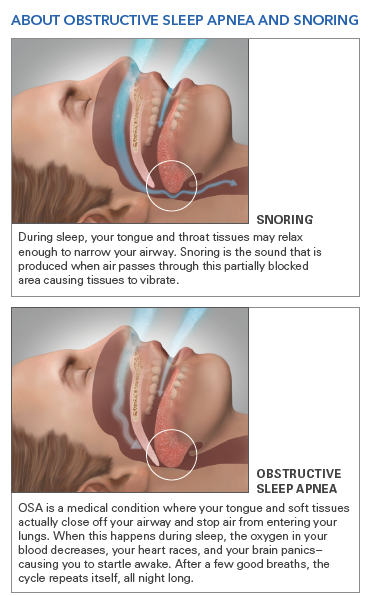
The word apnea means without breath. While sleeping, you may have partial pauses (hypopnea) or complete pauses (apnea) in breathing. The accumulation of these events occurring all night long results in extended periods of time of decreased blood oxygen levels. Night after night, your brain and vital organs can be starved of oxygen.
What is concerning? Most individuals are not even aware this is occurring. These events can occur hundreds of times per night. Yet, when we wake up the next morning and still feel tired or unrested, we attribute this to our busy lifestyle or state “I have never slept well” and simply accept this.
Don’t you think there could be a potential underlying cause for this?
Causes and Symptoms
When we sleep, the muscles and tissues in our body relax. The combination of this drop in muscle tone with gravity allows the tongue and surrounding soft tissues in the neck to drop back and constrict or fully obstruct the airway.

Health affects


Do you exhibit any of the following signs or symptoms?
- Snoring
- Frequent morning headaches
- Know clenching or grinding of your teeth? Or have you been told this by your spouse/significant other or dentist?
- Frequent need to use the restroom throughout the night
- Acid reflux
- High blood pressure
- A-Fib
Completing a sleep test is the only way to rule out sleep apnea as a potential underlying cause for each of the conditions listed above.
We can help facilitate this entire process for you. Either through our connections with local sleep centers or via telemedicine and an at home sleep test mailed directly to your home.
CPAP Alternative
Oral Appliance Therapy
A comfortable alternative to CPAP therapy
Custom oral sleep appliances are fitted by a dentist with specialized knowledge and training in dental sleep medicine to effectively treat obstructive sleep apnea. These appliances fit in the mouth, similar to a mouth guard, on both the top and bottom teeth. By passively positioning your lower jaw forward, this holds your tongue in a forward position, ensuring your airway remains open while you sleep. These appliances are comfortable and, more importantly, effective at treating obstructive sleep apnea.
Sleep apnea varies in the level of severity and type. The completion of an at home sleep study provides all necessary information to best treat the condition. Some patients may require the use of a CPAP, but many can be treated with the use of an oral sleep appliance.
- Custom fit
- No hoses or tubing attached to you while you sleep
- No noise from any machine
- No mask strapped to your face
- No electricity required
- Comfortable
- Easy to use
- Easy to clean
- Small and portable
- Reduces or eliminates grinding (bruxism)
Contact us if you currently have a CPAP and struggle with the nightly use or feelings of claustrophobia associated with the mask.
Some patients tolerate a CPAP just fine – and that is great. But many individuals also struggle with the nightly use so much that they discontinue wearing it all together. As a result, there is no management of their obstructive sleep apnea.
Common struggles:
- Unconscious need to remove CPAP
- Claustrophobic associations
- Disturbed or interrupted sleep
- Cumbersome
- Mask leaks
- Noisy
- CPAP restricts movement during sleep
- Discomfort from headgear
- Inability to fit the mask properly
- Noise disturbs sleep and/or bed partner’s sleep
- Latex allergy


What’s the process
4 Easy Steps to a Restful Night’s Sleep
1. Take the Sleep Apnea Risk Quiz

Click on the button below this timeline to complete a short online quiz to find out if you might be at risk for sleep apnea.
2. Request a FREE Consultation

We will have a conversation, provide an evaluation and discuss your options with you. There is no cost, no pressure and no obligation.
3. Take an At-Home Sleep Test

Be tested for sleep apnea in the comfort of your own bed and avoid the inconvenience of spending the night in a sleep testing lab.
4. Start Treatment

If you're diagnosed with sleep apnea, we will work with you to customize a treatment plan to help you breathe better, sleep better and feel better.
1. Take the Sleep Apnea Risk Quiz
Click on the button below this timeline to complete a short online quiz to find out if you might be at risk for sleep apnea.
2. Request a FREE Consultation
We will have a conversation, provide an evaluation and discuss your options with you. There is no cost, no pressure and no obligation.
3. Take an At-Home Sleep Test
Be tested for sleep apnea in the comfort of your own bed and avoid the inconvenience of spending the night in a sleep testing lab.
4. Start Treatment
If you're diagnosed with sleep apnea, we will work with you to customize a treatment plan to help you breathe better, sleep better and feel better.